


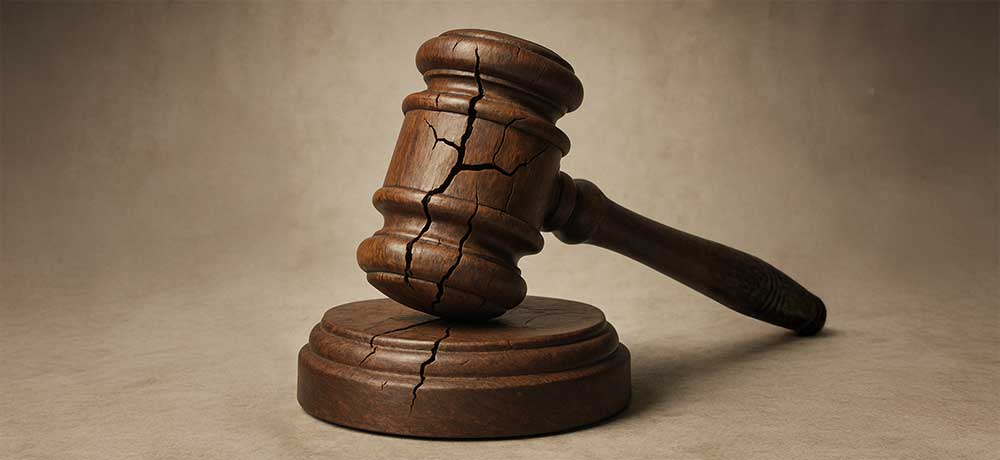
When the Rule of Law Cracks
I’ve spent enough time in national security spaces, including in conflict zones, to know the difference between fear and threat and between the hard work of protecting people and the easy, corrosive temptation to blame whole communities when something goes wrong.
The shooting of two members of the national guard in D.C. was a horrific act of violence. But the political response to it told a deeper story: one about how the rule of law erodes not in a single moment, but through the choices leaders make under pressure. This is not just a reaction to one incident; it’s a broader shift toward governing by fear, collective blame, and selective accountability.
That heaviness I felt this week wasn’t new. It was familiar.
Collective suspicion replaces security.
In Afghanistan, the people I worked alongside were often forced to navigate blanket suspicion. They had every reason not to trust anyone, yet they still stepped forward to help. They took risks most Americans will never fully understand as they put their faith in us. And they lived with the consequences of our decisions long after we moved on to the next mission.
So when I hear rhetoric suggesting that all Afghan evacuees are somehow a threat because of one individual’s act, it lands hard. People who stood shoulder to shoulder with us are now being treated as though they’re interchangeable with the worst version of a headline.
These are individuals who were vetted through one of the most intensive multi-agency processes in U.S. history. As Shawn VanDiver (TNSP Defense Council 2014), who has been fighting day in and day out for Afghan evacuees, has explained, the system was designed to honor our commitments while maintaining security. Yes, some oversight reports later raised concerns. Not because vetting was hollow, however, because Afghan record-keeping was often incomplete. What those findings revealed were data gaps, not a collapse of the vetting system itself.
Data gaps require better data. They don’t justify shutting the door on tens of thousands of people whose lives are already on hold.
What worries me most is that these decisions - pausing SIV visas, freezing asylum adjudications - are being justified with language that doesn’t match the facts. Asylum seekers are already here. They have already been screened. Halting their cases won’t make anyone safer; it will simply leave more people in permanent limbo.
And in the case of Afghan allies, this isn’t just policy drift. It’s breaking commitments written into federal law and supported by both parties. As Camille Mackler (TNSP Security Fellow 2019) reminded us several years ago in this vital piece, promise-keeping isn’t sentimental. It’s strategic. Future allies are watching how we treat the last generation we asked to stand with us.
Deflection becomes the norm.
What’s happening now has echoes in another story: the Venezuela boat strike, an operation ordered by Secretary of Defense Pete Hegseth. As political pressure builds, responsibility is quietly shifting away from the person who authorized the strike and onto a senior commander who followed the chain of command.
That is not how civilian-military accountability is supposed to work.
This isn’t two separate problems; it’s one pattern playing out in different ways. Broad, collective blame for vulnerable communities on one hand, and top-down scapegoating inside the chain of command on the other. Both trace back to the same failure of leadership: a willingness to deflect accountability rather than exercise it. This pattern doesn’t stop at immigration or the chain of command. It shows up at the very top. Meanwhile, the President pardoned a convicted drug trafficker long accused of cartel-linked corruption — a move viewed by many as political. It’s hard not to read it as a signal that loyalty, not legality, has become the currency in some corners of power.
When accountability becomes selective, the rule of law doesn’t bend a little. It cracks.
I’ve worked in places where the rule of law was fragile, inconsistent, or applied only to the powerless. I’ve seen what that does to people’s lives — how it corrodes trust, makes collective security nearly impossible, and drives communities into fear or retaliation instead of cooperation.
What’s frightening right now is that we’re flirting with those same dynamics here at home, not in a single dramatic moment, but through a thousand small decisions. None of these decisions alone ends a democracy. But together, they start to unravel the fabric that holds one together.
A return to principled accountability.
We don’t keep people safe by treating whole communities as suspects, nor do we preserve our democracy by shifting blame onto those with the least power to push back. Both instincts (collective suspicion and selective accountability) chip away at the rule of law in different ways, but with the same result: a more fragile, less trustworthy system.
I know how hard it is to hold the line when the politics get ugly. It’s tempting to look the other way or to convince ourselves that cutting corners is harmless. But shortcuts become habits, and habits become norms. And once broad suspicion and scapegoating replace legal standards, the rule of law doesn’t just weaken; it cracks.
We can choose differently. We’ve done it before. Our safety, our credibility, and our democracy depend on it - not on panic or blame, but on the steady, principled work of applying the law fairly and resisting the urge to govern by fear.


