


Who Polices the Abyss? Lawlessness at 4,000 Meters: China, Russia, and the Corporate Rush That Is Outrunning the World’s Only Seabed Regulator
A Flag in the Dark
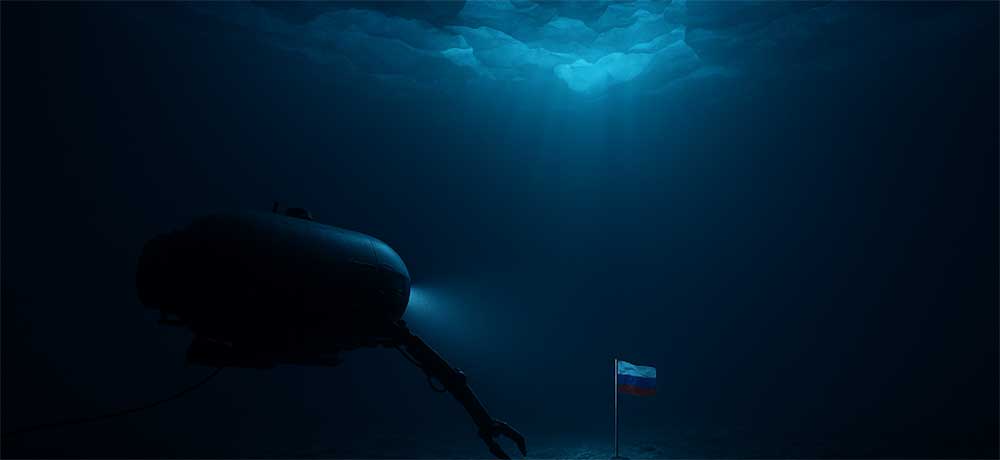
The submersible Mir-1 descended through the Arctic twilight on August 2, 2007, its floodlights cutting narrow corridors through water dense with drifting ice. Nearly three miles below the surface, the vehicle settled onto the seabed at the geographic North Pole, a place no human craft had ever reached. Then, in a gesture crafted for maximum geopolitical theater, the Russian expedition planted a titanium tricolor flag into the silty floor of the Arctic Ocean. “The Arctic has always been Russian,” a member of the Duma declared afterward, dismissing international protest as naïve hand-wringing. The stunt drew headlines, but it was not the real story. The flag was merely an opening salvo in a decades-long campaign: a methodical effort to secure legal recognition of Russia’s claim that the Lomonosov Ridge, stretching from Siberia to Greenland, was an extension of its continental shelf, and therefore entitled to vast sovereign rights over the seabed’s resources.[i]
In the years that followed, Moscow treated this claim not as a publicity exercise but as strategic statecraft. Russian survey vessels crisscrossed the Arctic, collecting bathymetric and geological data to buttress its submission to the UN Commission on the Limits of the Continental Shelf(CLCS). When the commission requested revisions, Russia submitted new scientific packages. When neighboring states objected, Moscow rebutted them with technical dossiers. The campaign has already spanned administrations, sanctions, and wars, because Russia views the seabed the way it once viewed aerospace: a frontier of national power, ripe for legal shaping and physical consolidation.[ii]
The episode revealed an uncomfortable truth: the institutions governing the seabed are nowhere near equipped to manage great-power competition occurring miles beneath the surface. The International Seabed Authority (ISA), based in Kingston, Jamaica, has neither the budget nor the enforcement capacity to police the accelerating rush for critical minerals and strategic access. The Law of the Sea, UNCLOS provides rules, but not the muscle to enforce them. Meanwhile, states like Russia and China are moving faster, legally, technologically, and operationally, than a fragile regime built for a slower era can absorb. What happens at depth is no longer a scientific curiosity; it is an emergent battleground for economic power, military advantage, and geopolitical leverage.
The Seabed as the Next Competitive Domain
For most of human history, the deep ocean floor existed beyond strategy, too remote to govern, too hostile to exploit, too dark to surveil. That era is over. The seabed now sits at the nexus of technological acceleration, resource scarcity, and great-power rivalry. Its mineral reserves, long theoretical, have become economically irresistible. The Clarion-Clipperton Zone (CCZ) alone is estimated to contain more cobalt, nickel, and rare-earth elements than all known terrestrial reserves, metals indispensable for batteries, renewable energy systems, and advanced defense technologies.[iii] As states race to secure supply chains for the energy transition and next-generation weapons systems, the CCZ has become a strategic prize disguised as a stretch of empty ocean.
Simultaneously, the cost of reaching and working on the seabed has plummeted. Advances in remotely operated vehicles (ROVs), autonomous underwater vehicles (AUVs), and seafloor sensor networks, including emerging SMART Cable architectures, have lowered the barrier to entry for actors ranging from state-owned enterprises to private exploration firms. What once required a fleet of specialized vessels and multi-national funding now requires modest capital, commercial robotics, and a permissive flag state. The seabed is increasingly accessible to actors who have little incentive to respect fragile governance norms.
This competition unfolds atop, and occasionally entangles, other vital infrastructure. Submarine telecommunications cables carry 99 percent of global data. SMART Cables promise to add seismic, temperature, and pressure sensors to the network, transforming the deep ocean into a real-time observatory. Militaries are deploying specialized surveillance nodes on the seafloor, and intelligence services are mapping subsea cable routes with precision once limited to nuclear-submarine warfare. Meanwhile, melting polar ice is opening new arcs of access in the Arctic, and geopolitical interest is expanding rapidly across the remote Pacific and Southern Ocean seabeds. Surface fleets project power above; attack submarines maneuver below; but the seabed is emerging as a third, distinct layer of maritime competition, where infrastructure, minerals, and data converge into a single strategic domain.
The Promise and Fragility of the ISA / UNCLOS System
The modern architecture governing this new domain rests on a deceptively simple principle. Under the UN Convention on the Law of the Sea, the seabed beyond national jurisdiction, known as “the Area”, is designated as the “common heritage of mankind,” to be managed for the benefit of all nations, not merely those with technological or financial reach.[iv] The International Seabed Authority was created to operationalize that principle. Its core responsibilities include issuing exploration licenses, negotiating and implementing a mining code, monitoring environmental impacts, and enforcing compliance on the high seas.
In theory, this structure provides a rules-based framework for an otherwise ungoverned frontier. In practice, it is struggling under the weight of geopolitical, economic, and technological forces that far exceed its design parameters. The ISA is critically underfunded and understaffed relative to the scale and complexity of what it is expected to regulate.[v] Its expert bodies juggle responsibilities that range from environmental science to commercial law to maritime enforcement, tasks that would strain a large national regulator, let alone a small organization with fewer than 40 employees.
Politically, the ISA is fractured. Pro-mining states push for rapid commercialization; small island states express ambivalence as they balance potential revenue against ecological risk; and environmental coalitions advocate moratoria or prohibitions. These divides are not merely philosophical, they materially shape the pace and structure of rule making. Despite the activation of the so-called “two-year rule,” which obligates the ISA to consider mining applications even without a completed code, the organization remains years away from finalizing a robust, enforceable set of regulations.[vi] Commercial actors, sensing regulatory drift, are already signaling their impatience. Some are quietly exploring alternatives outside the ISA system.
Even if the ISA completes a mining code, another problem looms: enforcement. Scholarship and internal analyses have repeatedly underscored the gaps in inspection powers, liability rules, and real-time monitoring capacity.[vii] Unlike traditional maritime authorities, the ISA cannot board vessels, cannot compel flag states to participate in inspections, and cannot deploy its own surveillance assets. It lacks a standing inspectorate, let alone the ability to intervene when a contractor violates environmental or operational requirements. Enforcement, in practice, depends on the willingness of sponsor states, and the compliance of the very corporate actors who stand to profit most.
In effect, the ISA resembles a small-town zoning board asked to regulate Wall Street. It has the mandate to oversee an industry of enormous strategic and economic importance, but not the legal instruments, institutional heft, or political unity to enforce its own rules. And as great powers race ahead, the mismatch between authority and capability grows more dangerous, not only for marine ecosystems, but for geopolitical stability.
How Great Powers and Corporations Are Outrunning the Rules
Even as the ISA struggles to finalize a basic regulatory framework, the world’s most capable actors have already moved to shape the seabed on their own terms. Nowhere is this more evident than in China, which has quietly become the most influential player within the ISA system. Beijing holds more deep-sea exploration contracts than any other country, leveraging state-backed enterprises and research institutes to secure a commanding position in the Clarion-Clipperton Zone.[viii] While nominally operating within the rules, China uses the slow grind of multilateral negotiation to its advantage. In mining-code debates, Chinese delegations have repeatedly steered outcomes toward permissive environmental baselines, flexible reporting requirements, and contractor-friendly liability structures, conditions that favor state-owned giants poised for commercial extraction.[ix] The result is a form of lawfare at depth: Beijing is not defying the rules; it is rewriting them from inside the system, locking in precedents before any other power can respond.
Russia pursues a different, but equally consequential, strategy. Its Arctic campaign is not merely a scientific effort to document geological continuity; it is a long-term legal warfare operation designed to normalize expansive interpretations of continental shelf entitlements. Through repeated submissions to the Commission on the Limits of the Continental Shelf, Moscow has pressed claims that would give it sovereign rights over vast portions of the Arctic seabed if accepted.[x] Each revised claim, each scientific expedition, and each rebuttal submitted through the CLCS process accumulates weight over time. By operating relentlessly within UNCLOS mechanisms, Russia seeks to redefine the legal landscape, not through force, but through procedural persistence.
Corporations are now joining states in testing the boundaries of the regime. With no final mining code in place and commercial timelines slipping, several companies have signaled that they may pursue alternative pathways to exploitation, such as domestic licensing schemes or bilateral arrangements with coastal states.[xi] Some have even explored reflagging their vessels under jurisdictions more tolerant of experimental or lightly regulated operations. These moves may be legally tenuous, but they reflect a hard reality: corporate actors, empowered by capital and robotics, can now outrun slow-moving international institutions.
Pacific Island states, often portrayed as moral arbiters in global ocean politics, are caught in the crossfire. Some, like Nauru, have actively sponsored mining contractors to accelerate ISA deliberations. Others are deeply skeptical, mindful that mining within their exclusive economic zones (EEZs) could bring both revenue and ecological disruption. National debates across the Pacific have increasingly diverged from ISA norms, highlighting the fragmentation between coastal-state governance and high-seas regulation.[xii] What emerges is not a unified regime but a patchwork of overlapping authorities, incompatible incentives, and competing interpretations of ocean stewardship.
Taken together, these dynamics represent a slow-motion erosion of the “common heritage of mankind”. Every unilateral workaround, whether state-led, corporate-driven, or jurisdictional, weakens the legitimacy of ISA governance. As actors learn they can circumvent or dilute the rules with little consequence, behavior begins to align not with international stewardship but with classic great-power opportunism. The deeper the world looks into the abyss, the more it begins to resemble a frontier governed by expediency rather than law.
Sensor Enabled Cables, Strategic Infrastructure, and the Militarization of the Seabed
Mining is only one part of the story. The seabed is increasingly a dense, contested landscape of cables, sensors, observatories, and military hardware, far more complex than the regulatory frameworks built to oversee it. Sensor enabled commercial data cables, such as SMART Cables equipped with environmental sensors embedded in telecommunications repeaters, offer unprecedented insight into seismic activity, pressure changes, and deep-ocean temperature patterns. They promise scientific breakthroughs and lifesaving early-warning systems. But they also blur the line between civilian and military infrastructure.
A sensor-enabled cable does not simply transmit internet traffic; it generates high-frequency data streams that can, in certain configurations, reveal vessel movements, submarine signatures, or disturbances along cable routes. What begins as climate data can become strategic intelligence. In the wrong hands, or placed in the wrong waters, such systems could enhance maritime domain awareness for states seeking to monitor U.S. or allied naval operations. As deep-sea mining contractors deploy large machinery and support vessels, their activities could be used, intentionally or not, to mask operations aimed at tapping, disrupting, or mapping subsea cables.
Seabed observatories and acoustic arrays add another layer of ambiguity. These platforms, often framed as scientific infrastructure, offer persistent situational awareness in strategically sensitive waters. A network of acoustic sensors deployed under the guise of marine research can double as an anti-submarine surveillance grid. Similarly, deep-sea “research” missions by Chinese and Russian vessels have repeatedly raised concerns among Western navies about potential reconnaissance of cable routes or reconnaissance for future seabed warfare.
This ambiguity fuels growing anxiety in Washington, Tokyo,Canberra, and European capitals. When Chinese state-linked contractors operate near sensored cable routes in the Indo-Pacific, or when Russian “oceanographic”vessels linger near Arctic data nodes, the line between scientific exploration and military preparation becomes dangerously thin. Unlike mining, which has a regulatory home within the ISA, seabed infrastructure sits at the intersection of science, commerce, and national security, yet no international body governs it comprehensively.
The problem is not only regulatory blind spots; it is conceptual. ISA and UNCLOS frameworks were designed around mineral extraction, not around the integrated seabed domain now emerging. They treat cables as private infrastructure, observatories as research installations, and defense systems as beyond their mandate. But at depth, these categories are inseparable. Mining machinery may disrupt early-warning systems. Research missions may facilitate military mapping. The seabed is no longer a collection of discrete activities, it is a single, interdependent battlespace.
The Enforcement Vacuum: Law on Paper, Impunity in Practice
If the seabed is becoming a competitive domain, the international community has few tools to police it. UNCLOS delegates enforcement almost entirely to flag states, which vary wildly in capacity and political will. There is no standing international enforcement mechanism, no rapid-response capability, and no dedicated authority to monitor and interdict unlawful seabed operations.[xiii] The ISA cannot deploy inspectors at sea; it cannot compel compliance in realtime; it cannot board vessels acting suspiciously beyond national waters.
Jurisdictional puzzles further complicate enforcement. A contractor may be sponsored by one state, flagged to another, operating in waters near a third state, and subject to ISA regulations only indirectly. If a flag state refuses inspection, challenges ISA competency, or disputes data interpretation, there is no binding mechanism to resolve the disagreement quickly. These gaps are not theoretical. They are the inevitable product of a regime designed for a slow, predictable, and relatively uncontested era of ocean governance.
Operational realities widen the gap between law and behavior. Unlike counter-piracy missions, which benefit from years of naval investment and intelligence-sharing, seabed activities are largely invisible. ISR assets are limited. Satellites can track vessels but not what they are doing below 4,000 meters. Autonomous underwater vehicles can monitor the seabed, but no state deploys them at the scale required for global oversight.Contractors and national navies know vastly more about seabed operations than regulators ever will. This information asymmetry allows violations to go undetected, or unproven, even when suspected.
Consider a plausible scenario: A Chinese-flagged support vessel operating in the Clarion-Clipperton Zone begins altering its AIS transmission pattern, briefly “going dark” before resuming course at a slightly different heading. Western analysts suspect it deployed a remotely operated vehicle to inspect a nearby subsea cable node. The ISA receives a complaint but lacks the assets to verify the incident. The flag state denies wrongdoing. The sponsoring state invokes confidentiality provisions. And the contractor insists that any gaps in AIS were due to mechanical faults. The incident disappears into procedural ambiguity.
This is not an aberration, it is the default. The first commercial mining operation, the first cable interference incident, the first military exploitation of a seabed sensor gap will set precedents, not because states deliberate and agree, but because institutions lack the capacity to intervene. In a domain where enforcement is nearly impossible, impunity becomes a structural feature, not a failure.
Policy Recommendations: Making Seabed Governance Strategic
The accelerating contest for the deep ocean will not wait for institutions to catch up. If the United States and its allies want a rules-based seabed, rather than one defined by opportunism and coercion, they must treat seabed governance as a strategic priority. That requires building capacity where it is weakest, updating rules where they are obsolete, and creating new coalitions where multilateral bodies cannot keep pace.
1. Rebuild the ISA as a Strategic Institution, Not a Technical Backwater
- Substantially increase assessed and voluntary contributions to the ISA to expand staffing, scientific capacity, legal expertise, and compliance operations.[xiv]
- Deploy long-term secondments from national geological surveys, maritime regulators, climate agencies, and naval oceanography commands.
- Embed dedicated science, compliance, and security experts in Kingston to ensure the ISA can evaluate environmental baselines, scrutinize contractor data, and anticipate national-security implications of seabed operations.
2. Modernize the Mining Code and Inspection Regime Before the First Commercial Extraction
- Establish clear and independently verifiable environmental baselines, durable liability frameworks, and mandatory transparency requirements, including data-sharing obligations for contractors and sponsoring states.[xv]
- Create a professional ISA inspectorate with guaranteed access provisions, modeled partly on nuclear-safeguards regimes.
- Require sponsoring states, especially technologically advanced ones, to provide inspection support vessels, autonomous monitoring platforms, or dedicated ISR contributions under binding agreements.
3. Stand Up a Seabed Situational Awareness Network
- Leverage commercial satellite data, AIS analytics, and emerging subsea telemetry, including SMART Cable sensor data, to provide real-time or near-real-time visibility into seabed operations.
- Fuse data from national oceanographic fleets, undersea cable infrastructure, hydroacoustic networks, and allied naval patrols into a shared operational picture.
- Establish a dedicated fusion center that serves both ISA compliance functions and allied maritime domain awareness, reducing the current asymmetry between contractors and regulators.
4. Use Club Coalitions to Backstop Weak Multilateralism
- Form a coalition of “seabed governance first movers”, the United States, EU members, Japan, Australia, New Zealand, and key Pacific and Arctic partners, to commit to high regulatory standards, joint inspections, and coordinated sanctions for violators.
- Tie access to Western capital markets, critical mineral supply chains, and export-financing arrangements to compliance with this coalition’s rules.
- Use the coalition’s economic and political weight to shape global expectations in advance of ISA rulemaking, rather than react to unilateral moves by China or Russia.
5. Integrate Seabed Governance into National SecurityStrategy
- Treat ISA negotiations and UNCLOS-plus arrangements as national-security imperatives, not environmental or technical side projects, which they have often been by default.[xvi]
- Elevate seabed governance within national strategies on intelligence, critical minerals, cyber and subsea cable protection, and climate resilience.
- Institutionalize seabed expertise across defense and intelligence communities, including scenario planning for mining incidents, cable disruptions, and dual-use surveillance risks.
- (Optional, if desired) Support eventual U.S. ratification of UNCLOS to strengthen credibility and influence within the system, an action long recommended by bipartisan national-security leaders.
These steps will not eliminate competition at depth. But they can ensure that competition occurs within a rules-based framework rather than a vacuum of authority, a vacuum that revisionist powers are already exploiting.
Conclusion: Avoiding a “Scramble for the Seabed”
The deep ocean is no longer a distant frontier. It is becoming a crucible of 21st-century power, rich in critical minerals, threaded with strategic infrastructure, and increasingly accessible to states and corporations with the technology and ambition to shape it. If the international community fails to adapt, it risks sleepwalking into a scramble for the seabed reminiscent of earlier eras of resource competition, but with far higher stakes and far fewer constraints.
Unlike past scrambles, this one will not unfold on the world’s visible frontiers but in the unlit spaces beneath them. Mining operations, SMART-enabled cables, and military observatories will converge in the same narrow corridors of seabed terrain. Incidents will be hard to detect, harder to attribute, and harder still to regulate. Without serious reform, the institutions meant to govern the seabed, above all the ISA, will be overwhelmed by the velocity of geopolitical and technological change. And as rules fall behind reality, the vacuum will reward those most willing to test the limits of impunity.
The seabed is not just about minerals. It underwrites global data flows, anchors early-warning systems, shapes naval strategy, and increasingly influences climate modeling and disaster forecasting. It is a foundation of economic security, environmental resilience, and geopolitical stability. Yet the institutions charged with managing it remain underpowered, understaffed, and structurally mismatched to the challenges ahead.
Preventing disorder at depth requires acknowledging thatKingston is not a peripheral forum, it is a front line. What happens in ISA meeting rooms will influence global power balances just as surely as what happens in Brussels, Geneva, or New York. Strengthening the seabed governance regime is not an act of environmental stewardship alone; it is an act of strategic foresight.
The world still has a narrow window to avoid a future defined by contested mining sites, cable interference incidents, and creeping militarization on the ocean floor. But that window closes quickly. If the seabed becomes a lawless domain, the consequences will ripple across the entire international system. If, instead, states invest now in credible rules, real monitoring, and shared governance, the seabed can remain a domain of stability rather than confrontation.
The choice, between a rules-based seabed and a free-for-all abyss, will shape the next century. It is time to treat it that way.
_________________________________
[i] AmericanSociety of International Law. “Russia's Claim in the Arctic and the VexingIssue of Ridges in UNCLOS.” ASIL Insights, November 2007.https://www.asil.org/insights/volume/11/issue/27/russias-claim-arctic-and-vexing-issue-ridges-unclos
[ii] AmericanSociety of International Law. “Russia’s Proposed Extended Continental Shelf inthe Arctic Ocean: Science Setting the Stage for Law.” ASIL Insights, May 2021.https://www.asil.org/insights/volume/25/issue/8
[iii] Wang,C., Zhou, S., Shu, X. et al. Deep-sea mining: a potential solution to securecritical energy minerals availability. npj Ocean Sustain 4, 59 (2025).https://doi.org/10.1038/s44183-025-00162-1
[iv] UnitedNations. United Nations Convention on the Law of the Sea, Part XI.https://www.un.org/depts/los/convention_agreements/texts/unclos/unclos_e.pdf
[v] PewCharitable Trusts. “Why Deep-Seabed Mining Needs a Moratorium.” Pew, 2025.https://www.pew.org/en/research-and-analysis/fact-sheets/2025/06/why-deep-seabed-mining-needs-a-moratorium
[vi] MongabayNews. “Deep-sea mining rules delayed two more years; mining start remainsunclear.” Mongabay, 2023.https://news.mongabay.com/2023/07/deep-sea-mining-rules-delayed-two-more-years-mining-start-remains-unclear/
[vii] InternationalSeabed Authority; Pew Charitable Trusts. Reports on compliance, inspectionmechanisms, and governance gaps. “The Pew Charitable Trusts Intervention onInspection, Compliance and Enforcement Mechanism”. https://www.isa.org.jm/wp-content/uploads/2024/05/Pew-Charitable-Trusts_Intervention-on-Greenpeace-protest-in-NORI-D-contract-site_agenda-item-20.pdf
[viii] Carnegie Endowment for International Peace. “Why China, Not the United States,Is Making the Rules for Deep-Sea Mining.” Carnegie, 2023.https://carnegieendowment.org/research/2023/12/why-china-not-the-united-states-is-making-the-rules-for-deep-sea-mining?lang=en
[ix] CarnegieEndowment for International Peace. “Why China, Not the United States, Is Makingthe Rules for Deep-Sea Mining.” Carnegie, 2023.https://carnegieendowment.org/research/2023/12/why-china-not-the-united-states-is-making-the-rules-for-deep-sea-mining?lang=en
[x] DevelopmentInstitute for Policy Analysis and Monitoring (DIPAM). “Russian Strategy in theArctic: The Case of Lomonosov Ridge.” DIPAM, 2024.https://dipam.org/wp-content/uploads/2024/03/Russian-Strategy-in-Arctic-The-Case-of-Lomonosov-Ridge.pdf
[xi] RANDCorporation. “Seabed Safety, Security, and Stewardship.” RAND, 2025.https://www.rand.org/content/dam/rand/pubs/research_reports/RRA3000/RRA3019-3/RAND_RRA3019-3.pdf
[xii] AsiaMaritime Transparency Initiative. “Between Rocks and a Hard Place: SeabedMining in the Pacific.” AMTI, 2025.https://amti.csis.org/between-rocks-and-a-hard-place-seabed-mining-in-the-pacific/
[xiii] Pew Charitable Trusts. “Seabed Mining Moratorium Is Legally Required by U.N.Treaty, Legal Experts Find.” Pew, 2023.https://www.pew.org/en/research-and-analysis/fact-sheets/2023/06/seabed-mining-moratorium-is-legally-required-by-un-treaty-legal-experts-find
[xiv] PewCharitable Trusts. “Push to Mine Seabed in International Waters Faces LegalHurdles.” Pew, 2025.https://www.pew.org/en/research-and-analysis/articles/2025/02/26/push-to-mine-seabed-in-international-waters-faces-legal-hurdles
[xv] MongabayNews. “Deep-sea mining’s future still murky as negotiations end on mixed note”Mongabay, 2024.https://news.mongabay.com/2024/04/deep-sea-minings-future-still-murky-as-negotiations-end-on-mixed-note/
[xvi] PewCharitable Trusts. “Push to Mine Seabed in International Waters Faces LegalHurdles.” Pew, 2025.https://www.pew.org/en/research-and-analysis/articles/2025/02/26/push-to-mine-seabed-in-international-waters-faces-legal-hurdles


