


The High Ground: Solving Spaceflight’s Hidden Medical Risk
On February 6, 2026, American astronauts are poised to leave Earth once more for the Moon. It will be the first human voyage beyond low-Earth orbit in more than half a century, and the first crew to visit the Moon since 1972.1 The Artemis program is meant to do more than plant a flag. It is the prologue to building a permanent presence on the lunar surface, a stepping-stone to Mars, and a bold assertion of U.S. leadership in the next great contest for strategic high ground.2
But as Washington pours billions into rockets, capsules, propulsion systems, and lunar habitats, one of the most formidable barriers to long-term success remains unsolved and largely underfunded.3 It is not a matter of technology or metallurgy. It is biology. Specifically, it is what NASA flight surgeon Dr. Bill Tarver and aerospace optometrist Dr. Tyson Brunstetter have identified as one of the most serious medical risks to exploration-class missions: Spaceflight Associated Neuro-ocular Syndrome (SANS), a condition that silently degrades vision and may impair astronaut performance on missions lasting months or years.4 Unless the United States addresses this hidden vulnerability, its ambitions to build and defend a lunar base will rest on shaky ground.
A Return to the Lunar Frontier
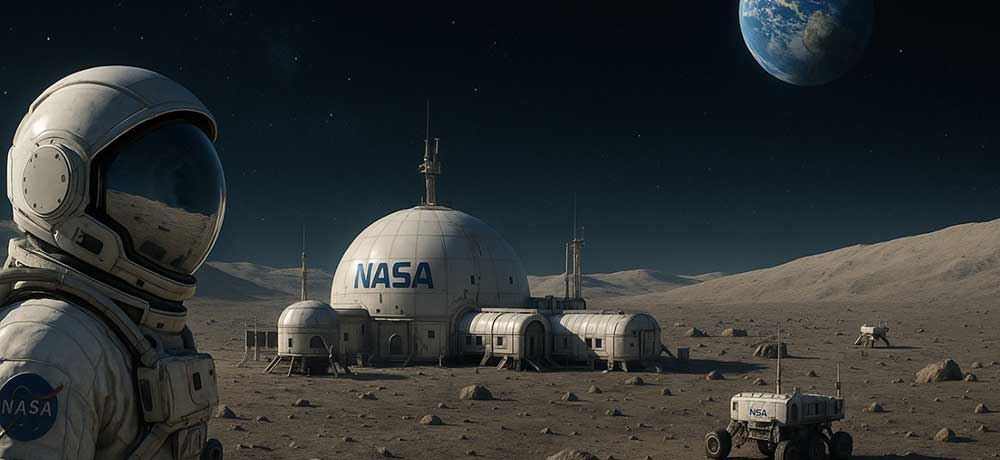
The Artemis program is the centerpiece of America’s new era in space. Artemis II, scheduled for launch in April 2026, will orbit the Moon with crew aboard.5 Artemis III, now targeted for 2027, will put U.S. astronauts back on the surface, at the lunar south pole.6 There, NASA plans to build the Artemis Base Camp, a permanent foothold to test technologies and prove endurance before attempting Mars.7
These plans are not symbolic. A functioning lunar base would expand U.S. reach across cislunar space, the zone between Earth and the Moon that is quickly becoming the next strategic theater.8 It would allow exploitation of lunar resources, like water ice that can be converted into rocket fuel, and provide a launch platform from a gravity one-sixth that of Earth’s.9 10 It would also extend surveillance and communications networks, supporting the Space Force’s mandate to secure U.S. access and freedom of action in space.11
China, meanwhile, has announced its own International Lunar Research Station (ILRS), targeted for the 2030s, in partnership with Russia and other states.12 Beijing has already placed landers and rovers on the lunar surface and aims to land taikonauts within the decade.13 14As with hypersonics, 5G, and artificial intelligence, space exploration is now another front in a systemic competition between Washington and Beijing.15 Control of the lunar frontier will shape not only scientific discovery, but also geopolitical leverage and military advantage.16
Against this backdrop, the Artemis program is more than a scientific project; it is a national security imperative.17 Yet its success hinges not just on engineering and budgets, but on whether human beings can endure, perform, and thrive in environments far from Earth.18
The Overlooked Barrier: Spaceflight Associated Neuro-ocular Syndrome
Since the dawn of the Space Age, much has been made of radiation, bone loss, and muscle atrophy.19 These risks are real. But a quieter, less understood condition now ranks among NASA’s highest “red risks”: Spaceflight Associated Neuro-ocular Syndrome (SANS).20
SANS manifests when the absence of gravity redistributes fluids in the human body.²¹ On Earth, gravity pulls blood and other fluids downward, helping regulate pressure across the brain, eyes, and spine. In microgravity, or even in partial gravity such as the Moon, this balance is disrupted.²² Fluids migrate toward the head, pressing on delicate structures around the optic nerve and retina. The result is swelling, wrinkling of the retina, globe flattening, and, in many cases, a measurable decline in visual acuity.²³
Studies of International Space Station (ISS) crews suggest that approximately 70% of astronauts on long-duration missions develop some features of SANS, from optic disc edema to hyperopic refractive shifts, from mild to severe.²⁴²⁵ Dr. Brunstetter notes that while glasses may correct some deficits, structural changes in the eye are more concerning. “We are seeing evidence of permanent alterations to ocular anatomy,” he explains. “The long-term implications, especially over multiple missions, are not fully understood.”²⁶
Dr. Tarver, NASA’s SANS clinical lead, has emphasized that this is not merely an academic issue. A pilot returning from Mars, he warns, might need to land a spacecraft with degraded vision.²⁷ In lunar or Martian bases, impaired sight could compromise safety, maintenance, and even survival.²⁸
The problem is magnified by uncertainty. Researchers do not yet know whether one-sixth gravity is enough to halt or slow SANS progression.²⁹ Data from ISS show the condition begins to appear at around half of Earth’s gravity in analog studies, suggesting lunar settlers will be vulnerable.³⁰ “We cannot assume the Moon’s gravity is a safeguard,” Tarver stresses. “Until we test and measure, we must treat it as a live operational risk.”³¹
Why This Matters for Defense and Strategy
For Washington policy experts accustomed to thinking in terms of capabilities, costs, and competition, the question is simple: Why does SANS matter? The answer is threefold.
First, readiness. Spacefarers are not tourists; they are operators in high-risk environments. Their ability to perform precision tasks such as piloting landers, maintaining reactors, conducting surveillance, repairing life support, and performing emergency procedures depends on sharp vision and neurological stability.³² A degraded crew is a degraded force.
Second, resilience. In low-Earth orbit, medical evacuation is possible but extremely difficult; in deep space, it is effectively impossible.³³ Even on the International Space Station, where ground specialists can support crews in near real time, NASA recently ended a mission early and returned a crew after a medical concern, underscoring how quickly health issues can constrain operations in orbit.³⁴ That incident also highlighted the limits of onboard care and the premium on compact diagnostics and continuous monitoring—exactly the kind of capability exploration missions will need when return is no longer a practical option. If a condition like SANS progresses to functional blindness or neurological compromise, the mission may fail. For a lunar base, which would cost tens of billions to build and maintain, crew incapacity could trigger catastrophic financial and strategic losses.³⁵
Third, competition. China is watching closely.³⁶ If American crews struggle with health impairments while Beijing’s taikonauts establish a functioning outpost, the narrative of leadership could tilt.³⁷ In geopolitics, perception often counts as much as capability. Failing to anticipate and mitigate SANS risks could cede psychological and diplomatic advantage, undermining U.S. influence over lunar norms, resource rights, and strategic alliances.³⁸
A single impaired mission could waste decades of investment and hand Beijing the chance to claim that America cannot sustain human presence in deep space.³⁹
The Lunar Base and the Prospect of Future Space Wars
For now, the Outer Space Treaty prohibits the placement of weapons of mass destruction on celestial bodies such as the Moon.⁴⁰ But history shows that treaties are only as strong as the power behind them. In an era of great-power rivalry, a permanent U.S. presence on the Moon will inevitably carry military implications, whether Washington chooses to acknowledge them openly or not.⁴¹
A lunar base represents more than scientific prestige. It is a strategic stronghold.⁴² From the Moon, the United States would enjoy persistent line-of-sight to large swaths of Earth’s orbit, enabling enhanced surveillance, missile warning, and satellite monitoring.⁴³ Unlike fragile satellites that can be jammed or destroyed, a hardened lunar outpost could host large, redundant sensors, shielded by regolith or even built underground.⁴⁴ In a crisis, this capability would give U.S. commanders unique situational awareness in Earth orbit, a decisive edge in any conflict that extends into space.⁴⁵
The Moon also offers a logistical advantage. Its shallow gravity well makes it easier to launch payloads such as satellites, fuel depots, or, in the future, even defensive systems into cislunar space or back toward Earth orbit.⁴⁶ If competition with China escalates into confrontation, the ability to rapidly project or replenish space assets from lunar stockpiles could prove critical.⁴⁷ As military planners note, resupply in space is the equivalent of logistics on the ground: it is often the difference between endurance and collapse.⁴⁸
Finally, control of the Moon shapes control of cislunar space itself, the vast expanse between Earth and the Moon that U.S. Space Force leaders increasingly describe as the next operational theater.⁴⁹ Whoever dominates cislunar trajectories will be able to monitor, maneuver, and potentially interdict adversary spacecraft traversing those routes. As China pursues its International Lunar Research Station, Washington cannot afford to allow Beijing uncontested influence.
A functioning Artemis Base Camp would serve as both a tripwire and a deterrent, complicating adversary plans and signaling that the United States is prepared to defend its interests far beyond geostationary orbit. As one senior Space Force official remarked, “Future conflicts will not stop at Earth’s atmosphere.” The Artemis Base Camp is not only a beacon of exploration; it is a keystone of deterrence. Without it, America risks ceding the highest ground in human history to its greatest strategic competitor.
The Cost of Ignoring Biology
NASA’s budget for Artemis is estimated at more than $90 billion through 2025.⁵⁰ Much of that is rightly dedicated to rockets, capsules, and infrastructure. Yet only a small fraction addresses long-term human biology. In contrast, the costs of failure—measured in lost missions, grounded astronauts, or geopolitical setbacks—could be incalculable.
Consider defense cost modeling. If SANS incapacitates even one out of four astronauts on a multi-year Mars mission, redundancy requirements might force NASA to increase crew sizes, doubling life-support and logistics expenses. That could add billions in costs per mission. Worse, if vision impairment leads to mission aborts or emergency returns, the sunk cost of failed expeditions would dwarf the modest sums required today to research countermeasures.
As Dr. Philip Buscemi, who is developing portable diagnostic tools like the Goggle-Based Visual Field system, has argued, “Early detection and monitoring are crucial. We can’t afford to wait until a condition manifests fully in space. We need systems that can track ocular changes continuously, in situ.”⁵¹ In military terms, SANS is like a stealthy adversary infiltrating the ranks—one that can be anticipated, surveilled, and countered with the right investment.
Countermeasures and the Path Forward
Promising avenues exist. Researchers are testing lower-body negative pressure suits, which draw fluids downward to counteract headward shifts. Others are experimenting with pharmaceutical approaches, optimized sleep postures, or artificial gravity through short-radius centrifuges. Portable imaging devices, including Buscemi’s prototypes, aim to provide real-time monitoring without bulky lab equipment.
Yet these efforts remain underfunded and fragmented. To succeed, Washington must treat SANS as a strategic priority, not a side project. That means:
- Dedicated funding lines for SANS research in NASA budgets, ring-fenced from cuts.
- Cross-agency collaboration with the Department of Defense, DARPA, and NIH to leverage expertise in human performance under extreme environments.
- Operational integration, requiring that SANS countermeasures be embedded in spacecraft, habitats, and crew protocols from the design stage, not bolted on later.
- International coordination, using the Artemis Accords to align partner nations on health standards, monitoring protocols, and shared countermeasure testing.
High Ground Depends on Human Ground Truth
In strategy circles, the Moon is often described as the “ultimate high ground.” But high ground is meaningless if the soldiers holding it cannot see. As U.S. defense planners contemplate cislunar deterrence, lunar logistics, and competition with China, they must recognize that the battle for dominance will be fought not only with rockets and robots, but also with the fragile biology of the humans who crew them.
The United States has an opportunity to lead—not only in reaching the Moon first, but in proving it can sustain life and performance there. That requires addressing SANS with the same urgency devoted to propulsion systems or launch schedules.
As Dr. Tarver has put it, *“We’ve built extraordinary machines to take us farther than ever before. Now we must make sure the people inside them can go the distance.”*⁵² If Washington fails to heed that warning, America risks winning the race to the Moon only to lose the contest for the stars.
________________________________________
¹ NASA, “Artemis II Mission Overview,” NASA.gov, 2024
https://www.nasa.gov/mission/artemis-ii/
² NASA Office of Inspector General, NASA’s Management of the Artemis Missions, 2021
https://oig.nasa.gov/docs/IG-22-003.pdf
³ SpacePolicyOnline, “First Four Artemis Flights Will Cost $4.1 Billion Each, NASA IG Tells Congress,” 2021
https://spacepolicyonline.com/news/first-four-artemis-flights-will-cost-4-1-billion-each-nasa-ig-tells-congress/
⁴ Lee, A. G., Mader, T. H., Gibson, C. R., Tarver, W., Rabiei, P., Riascos, R. F., “Spaceflight Associated Neuro-ocular Syndrome,” npj Microgravity 4, Article 7 (2018)
https://www.nature.com/articles/s41526-020-0097-9
⁵ NASA, “Artemis II Mission Overview,” NASA.gov
https://www.nasa.gov/mission/artemis-ii/
⁶ NASA, “Artemis II Mission Overview,” NASA.gov
https://www.nasa.gov/mission/artemis-ii/
⁷ NASA, “Lunar Surface Sustainability Concept,” April 2020
https://www.nasa.gov/general/nasa-outlines-lunar-surface-sustainability-concept/
⁸ U.S. Space Force, “Spacepower: Doctrine for Space Forces,” 2020
https://www.spaceforce.mil/portals/1/space%20capstone%20publication_10%20aug%202020.pdf
⁹ Colaprete, Anthony, et al., “Detection of Water in the LCROSS Ejecta Plume,” Science 330, no. 6003 (2010): 463–468
https://www.science.org/doi/10.1126/science.1186986
¹⁰ Metzger, Philip T., “Space Development and Space Science Together, an Historic Opportunity,” Journal of Space Policy, 2016
https://arxiv.org/abs/1609.00737
¹¹ U.S. Space Force, “Spacepower: Doctrine for Space Forces,” 2020
https://www.ialpg.com/space-capstone-publication-spacepower-doctrine-for-space-forces/
¹² Global Times, “Basic Structure for ILRS to Be Built by 2028,” 2022
https://www.globaltimes.cn/page/202211/1280123.shtml
¹³ Xinhua, “China’s Chang’e-4 Lander on the Far Side of the Moon,” 2019
https://www.space.com/42676-china-moon-far-side-chang-e-4-mission-pictures.html
¹⁴ LiveScience, “China Plans to Build Moon Base at the Lunar South Pole by 2035,” 2024
https://www.livescience.com/space/space-exploration/china-plans-to-build-moon-base-at-the-lunar-south-pole-by-2035
¹⁵ SCMP, “China’s Moon Ambitions Take Shape with Roadmap for Research Station,” 2023
https://www.space.com/china-moon-base-south-pole-2035
¹⁶ CCP Central Committee Bimonthly Qiushi, “China Writes New Chapter in Space Exploration,” 2023
https://en.qstheory.cn/2023-04/28/c_882216.htm
¹⁷ U.S. National Space Policy, 2020
https://www.thespacereview.com/article/4554/1
¹⁸ Patel, Zarana, et al., “Red Risks for a Journey to the Red Planet,” Nature Microgravity 6, 33 (2020)
https://www.nature.com/articles/s41526-020-00124-6
¹⁹ Cucinotta, Francis A., and Eliedonna Cacao, “Risks of Space Radiation Exposure,” Life Sciences in Space Research 28 (2021): 18–29
https://www.sciencedirect.com/science/article/pii/S2214552421000584
²⁰ NASA, Human Research Program Integrated Research Plan, 2022
https://ntrs.nasa.gov/api/citations/20230006053/downloads/NASA-TM-20230006053.pdf
²¹ Roberts, D. R., et al., “Head-Down Tilt Bed Rest Studies as Analog for SANS,” Frontiers in Neurology 12 (2021): 648958
https://www.frontiersin.org/journals/ophthalmology/articles/10.3389/fopht.2024.1487992/full
²² NASA.gov, “Vision Changes in Space,” 2023
https://www.nasa.gov/humans-in-space/international-space-station-research-keeps-an-eye-on-vision-changes-in-space/
²³ Garcia, Hilda J., et al., “Changes in the Optic Nerve Head and Choroid Over 1 Year of Spaceflight,” Investigative Ophthalmology & Visual Science, 2021
https://pubmed.ncbi.nlm.nih.gov/33914020/
²⁴ Zwart, Sara R., et al., “Factors Associated with Development of Optic Disc Edema During Spaceflight,” JAMA Network Open, 2022
https://www.frontiersin.org/journals/ophthalmology/articles/10.3389/fopht.2023.1279831/full
²⁵ Eye (Nature), “Sleep and Optic Disc Edema in SANS,” 2024
https://pubmed.ncbi.nlm.nih.gov/38778142/
²⁶ Joe, Brenna, “Spaceflight Associated Neuro-ocular Syndrome,” NASA Human Research Program, October 2024
https://www.frontiersin.org/journals/ophthalmology/articles/10.3389/fopht.2024.1487992/full
²⁷ Tarver, William J., et al., Evidence Report: Risk of SANS, NASA HRP, 2017
https://ntrs.nasa.gov/citations/20180000936
²⁸ Tarver, William J., et al., Evidence Report: Risk of SANS, NASA HRP, 2017
https://ntrs.nasa.gov/citations/20180000936
²⁹ Ophthalmology, “Optic Disc Edema after 30 Days of Strict Head-Down Tilt Bed Rest,” 2019
https://pubmed.ncbi.nlm.nih.gov/30308219/
³⁰ Roberts, D. R., et al., “Head-Down Tilt Bed Rest Studies,” 2021
https://www.frontiersin.org/journals/ophthalmology/articles/10.3389/fopht.2024.1487992/full
³¹ Lee, A. G., et al., “Spaceflight Associated Neuro-ocular Syndrome,” npj Microgravity 4 (2018)
https://www.nature.com/articles/s41526-020-0097-9
³² Patel, Zarana, et al., “Red Risks for a Journey to the Red Planet,” Nature Microgravity 6, 33 (2020)
https://www.nature.com/articles/s41526-020-00124-6
³³ NASA, Space Medicine Exploration Class Missions Report, 2023
https://taskbook.nasaprs.com/tbp/index.cfm?action=taskbook_content_by_grant&grantid=10130
³⁴ Dunn, Marcia, “Astronauts Say Space Station’s Ultrasound Machine Was Critical During Medical Crisis,” AP News, January 21, 2026
https://apnews.com/article/d501e91736371525e81d13794d5e9f01
³⁵ SpacePolicyOnline, “NASA IG Artemis Costs,” 2021
https://spacepolicyonline.com/news/first-four-artemis-flights-will-cost-4-1-billion-each-nasa-ig-tells-congress/
³⁶ Global Times, “Basic Structure for Intl Lunar Research Station,” 2022
https://www.globaltimes.cn/page/202211/1280123.shtml
³⁷ SCMP, “China’s Moon Ambitions Take Shape,” 2023
https://www.space.com/china-moon-base-south-pole-2035
³⁸ U.S. Department of Defense, Defense Space Strategy Summary, 2020
https://media.defense.gov/2020/Jun/17/2002317391/-1/-1/1/2020_defense_space_strategy_summary.pdf
³⁹ Patel, Zarana, et al., “Red Risks for a Journey to the Red Planet,” Nature Microgravity 6, 33 (2020)
https://www.nature.com/articles/s41526-020-00124-6
⁴⁰ Outer Space Treaty, 1967
https://www.scribd.com/document/843033997/Article
⁴¹ The Space Review, “Taking Stock of the U.S. Space Program,” 2024
https://www.thespacereview.com/article/4751/1
⁴² Metzger, Philip T., “Space Development and Space Science Together,” Journal of Space Policy, 2016
https://arxiv.org/abs/1609.00737
⁴³ U.S. Space Force, “Spacepower Doctrine,” 2020
https://www.ialpg.com/space-capstone-publication-spacepower-doctrine-for-space-forces/
⁴⁴ NASA, “NASA’s Dust Shield Successfully Repels Lunar Regolith on Moon,” 2025
https://www.nasa.gov/image-article/nasas-dust-shield-successfully-repels-lunar-regolith-on-moon/
⁴⁵ U.S. Space Force, “Spacepower: Doctrine for Space Forces,” 2020
https://www.spaceforce.mil/portals/1/space%20capstone%20publication_10%20aug%202020.pdf
⁴⁶ Metzger, Philip T., “Space Development and Space Science Together,” Journal of Space Policy, 2016
https://arxiv.org/abs/1609.00737
⁴⁷ Patel, Zarana, et al., “Red Risks for a Journey to the Red Planet,” Nature Microgravity 6, 33 (2020)
https://www.nature.com/articles/s41526-020-00124-6
⁴⁸ NASA, “NASA Seeks Innovative Artemis Lunar Logistics, Mobility Solutions,” 2024
https://www.nasa.gov/general/nasa-seeks-innovative-artemis-lunar-logistics-mobility-solutions/
⁴⁹ U.S. Space Force, “Spacepower: Doctrine for Space Forces,” 2020
https://www.spaceforce.mil/portals/1/space%20capstone%20publication_10%20aug%202020.pdf
⁵⁰ NASA Office of Inspector General, NASA’s Management of the Artemis Missions, 2021
https://oig.nasa.gov/docs/IG-22-003.pdf
⁵¹ NASA Task Book, “Development of Advanced Vision Testing Software for a Goggle-Based Visual Field Device Prototype,” PI: Philip O. Buscemi, 2022
https://taskbook.nasaprs.com/tbp/index.cfm?action=public_query_taskbook_content&TASKID=11986
⁵² Ong, J., Brunstetter, T., Tarver, B., et al., “Spaceflight Associated Neuro-ocular Syndrome: Proposed Pathogenesis, Terrestrial Analogues, and Emerging Countermeasures,” British Journal of Ophthalmology 107, no. 7 (2023): 895–900
https://pmc.ncbi.nlm.nih.gov/articles/PMC10359702/


