


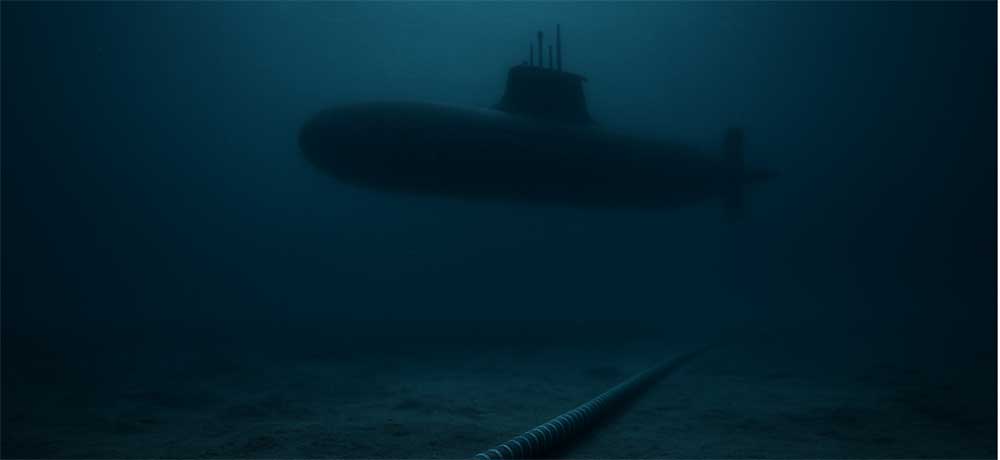
The Silent War Beneath the Arctic Seas: Why Securing Undersea Cables is a National Security Imperative
Few domains are as overlooked yet as indispensable to modern power projection as the ocean floor. Nearly all of the world’s internet traffic, more than 95 percent, transits through roughly 570 subsea fiber-optic cables.[i] These systems underpin not only the global economy but also the operational command and control of modern militaries. Despite their centrality, they remain vulnerable, exposed, and increasingly subject to foreign interference.
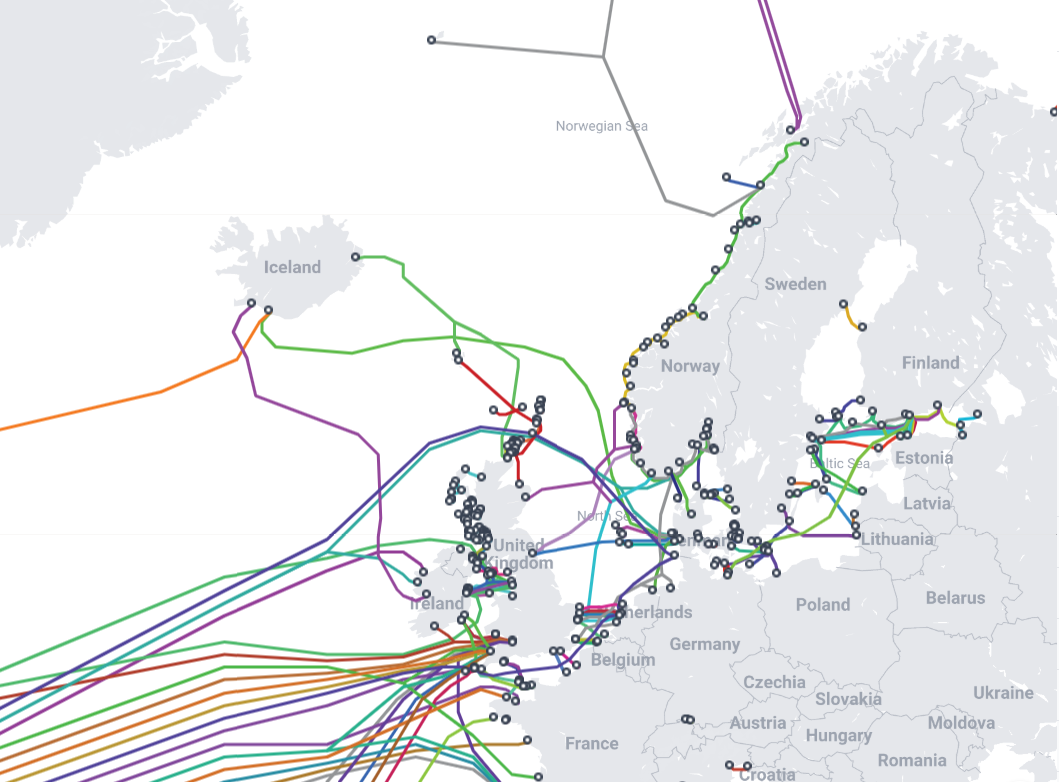
Recent incidents in the Baltic and Arctic Seas underscore that this is no hypothetical threat. In 2022 and 2023, suspected sabotage severed undersea cables connecting Norway’s Svalbard archipelago and disrupted communications in the Baltic Sea.[ii] Investigations linked the incidents to Russian-flagged or Russian-controlled commercial vessels.[iii] In parallel, Chinese state-owned enterprises have deployed vessels and unmanned systems capable of cutting cables at depth, framing such capabilities as“research” while leaving little doubt about their coercive potential.[iv]
The undersea battlespace has become an arena of hybrid warfare, gray-zone operations that stop short of open conflict yet impose significant costs and uncertainty. Left unaddressed, these operations risk eroding deterrence and emboldening adversaries to weaponize infrastructure that lies at the heart of national resilience.
The Arctic as a Strategic Fault Line
The Arctic is emerging as the most contested frontier in this struggle. With the retreat of sea ice, previously impassable routes, such as the Northern Sea Route and the central Transpolar Route, are opening to navigation.[v] This transformation has profound implications for energy transport, military basing, and digital connectivity. New cable projects linking Asia, Europe, andNorth America promise faster and more secure global internet pathways.[vi]
Russia has been quick to exploit this shift. Since 2014, Moscow has invested heavily in Arctic militarization, reopening Soviet-era bases, deploying nuclear-powered icebreakers, and expanding its fleet of submarines optimized for seabed operations.[vii] Its Main Directorate of Deep-Sea Research (GUGI) operates vessels such as the Yantar, which NATO suspects of mapping and potentially targeting undersea cables.[viii] Russia’s doctrine explicitly views the disruption of critical infrastructure asa legitimate tool in hybrid conflict, making Arctic cables a tempting target.[ix]
China, though lacking territorial claims, has declared itself a “near-Arctic state” and invested heavily in polar research stations, ice-capable ships, and undersea mapping expeditions.[x] Its Belt and Road Initiative now includes a “Polar Silk Road” that identifies trans-Arctic cables as strategic assets.[xi] Together, Russia and China have begun converging in the region, signing agreements on Arctic shipping, energy development, and oceanographic research.The dual-use nature of these activities, scientific on the surface, military in application, should alarm Western strategists.
The Limits of Passive Protection
The vulnerabilities of subsea cables are well understood:though armored and buried in shallow waters, they remain exposed along vast stretches of the seabed. A deliberate cut to a handful of critical cables could cripple transatlantic communications, disrupt financial markets, and degradeNATO’s ability to coordinate military operations.[xii] Repair operations, while possible, are slow and logistically complex, particularly in the harsh Arctic environment.
Traditional protective measures, redundancy, armored sheathing, and burial, are insufficient against state-sponsored sabotage. Adversaries are investing in remotely operated and autonomous underwater vehicles capable of targeting cables covertly.[xiii] Treating subsea cables as passive infrastructure leaves a trillion-dollar economy and global command-and-control structure effectively undefended.
SMART Cables as Strategic Infrastructure
A new approach is needed: transforming cables from inert infrastructure into active components of national defense. The most promising innovation is the integration of SMART Cables, Science Monitoring and Reliable Telecommunications systems that embed environmental sensors (seismic, pressure, and temperature) into commercial subsea fiber.[xiv]
Championed by the United Nations, SMART Cables provide continuous awareness of earthquakes and tsunamis in real time while supplying vital data for scientific research.[xv] Critically, they can detect anthropogenic disturbances, anchor dragging, trawling, seismic charges, submersibles, as well as natural hazards such as underwater landslides.[xvi] They transform cable networks into persistent maritime domain awareness platforms.
Europe is already moving forward. The EU, France, andPortugal are funding projects such as the Mediterranean Infrasound and Seismic Telecommunication System (MISTS), the Atlantic CAM cable, and the TamTam cable connecting New Caledonia and Vanuatu, all scheduled for operation by 2027 or 2028.[xvii] Future projects envision deployments across the Arctic, Antarctic, and Indo-Pacific. Each system will advance natural hazard monitoring and provid eessential climate data, while adding a new layer of deterrence in contested maritime regions.
Toward a Layered Defense
For the United States and its allies, integrating SMARTCables into broader defense architectures should be a priority. NATO’s “BalticSentry” initiative offers a template: combining seabed sensors, undersea drones, and naval patrols to create a layered defense of subsea infrastructure.[xviii] SMART systems could expand this approach to the Arctic, where surveillance gaps remain significant.
As retired Rear Admiral Tim Gallaudet warned, “Securing [undersea cables] from sabotage is a critical requirement for U.S. national security and economic prosperity.”[xix] Without new tools, adversaries will continue to exploit the blind spots of the seabed.
Policy Recommendations
Three priorities stand out:
- Federal and Allied Investment. Washington should fund SMART sensor integration on future U.S.-linked cable projects, beginning with those traversing the Arctic, in coordination with Canada, Iceland, and Nordic allies
- Intelligence-Sharing Frameworks. NATO and the EU should establish joint centers for monitoring subsea infrastructure, pooling SMART data with satellite and maritime surveillance fee
- Norms and Deterrence. The U.S. should lead efforts at the ITU and UN to establish norms against cable sabotage, backed by credible deterrence measures. Signaling that attacks on cables will be treated as strategic escalations can reinforce red lines.
Conclusion
The seabed is no longer a passive frontier; it is a contested battlespace central to 21st-century geopolitics. Russia and China recognize the leverage afforded by undersea infrastructure, particularly in the Arctic, where geography and technology converge to create both opportunity and vulnerability.
Integrating SMART Cables into defense strategy offers a dual-use solution, enhancing scientific understanding while closing critical gaps in national security. To delay is to cede initiative in an environment where adversaries already enjoy a head start. The silent war beneath the Arctic seas is underway. The United States and its allies must prepare accordingly.
______________________________________________
[i] Maritime Executive, “Study: Submarine DataCable Security Deserves Urgent Attention,” 2024.
[ii] Jamestown Foundation, “Hybrid Attacks Rise on UnderseaCables in Baltic and Arctic Regions,” 2024.
[iii] NBC News, “Undersea Cables Are Cut, SuspicionFalls on Russian, Chinese Vessels,” 2024.
[iv] Stephen Chen, “China Unveils Powerful Deep-Sea CableCutter,” South China Morning Post, 2024.
[v] Chatham House, “The Future of Arctic Shipping,”Chatham House Report, 2023.
[vi] Reuters Investigates, “U.S., China, and TechCompetition over Arctic Cables,” 2024.
[vii] Katarzyna Zysk, “Russia’s Arctic Strategy: Militaryand Security Dimensions,” Arctic Review on Law and Politics, 2021.
[viii] H.I. Sutton, “Russia’s Spy Ship Yantar andSubsea Cables,” Naval News, 2023.
[ix] RAND Corporation, “Russia’s Hybrid Warfare andCritical Infrastructure,” RAND Report, 2022.
[x] Anne-Marie Brady, China as a Polar Great Power(Cambridge University Press, 2019).
[xi] Marc Lanteigne, “China’s Emerging Arctic Strategy,”Norwegian Institute of International Affairs, 2022.
[xii] CSIS, “Invisible and Vital: Undersea Cables andTransatlantic Security,” CSIS Report, 2023.
[xiii] NATO Parliamentary Assembly, “Protecting SubmarineCables from Hybrid Threats,” NATO PA Report, 2022.
[xiv] UN Joint Task Force on SMART Cables, “SMART CablesInitiative,” 2025.
[xv] Bruce M. Howe et al., “SMART Cables for Observing theGlobal Ocean,” Frontiers in Marine Science, 2022.
[xvi] Science Magazine, “SMART Fiber-Optic Cables on the SeaFloor Will Detect Earthquakes, Tsunamis, and Global Warming,” Science,2023.
[xvii] European Union, “MISTS Project”; Infraestruturas dePortugal, “Atlantic CAM Project,” 2024.
[xviii] NATO, “Baltic Sentry: Protecting CriticalInfrastructure,” NATO Press Release, 2025.
[xix] Rear Admiral Tim Gallaudet, USN (Ret.), personalcommunication with Richards, April 15, 2025.


